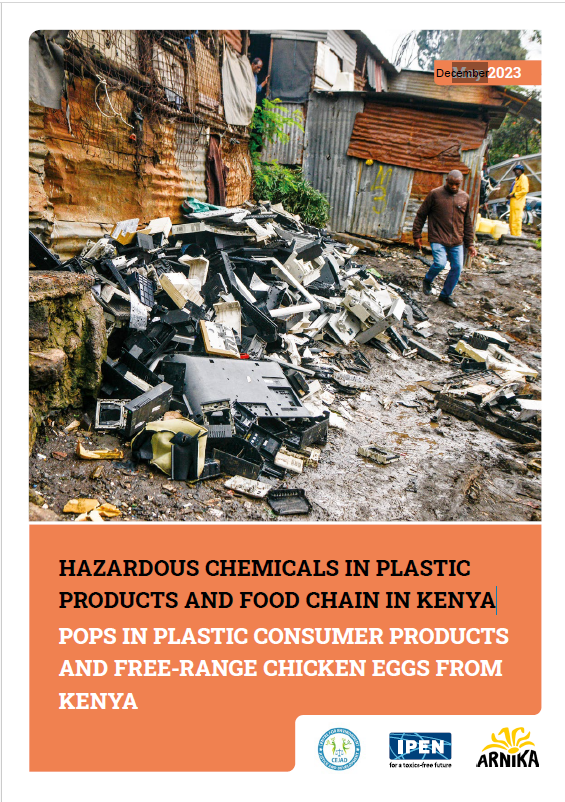

Developing countries, including Kenya, face significant environmental and health risks from toxic chemicals contained in electronic waste, plastic products, and other hazardous materials. Poor waste management practices such as dumping, informal recycling, and open burning release dangerous pollutants into the environment and food chain.
Objective
The study aimed to determine whether Persistent Organic Pollutants (POPs) from waste streams are entering consumer products and food sources in Kenya and to contribute evidence for stronger international and national regulations on hazardous chemicals.
Methodology
Free-range chicken eggs were collected from areas near dumpsites, e-waste dismantling sites, and facilities that burn plastic waste. Plastic consumer products made from black recycled plastics were also sampled from Kenyan markets. Laboratory analyses were conducted in certified laboratories in Europe to test for dioxins, PCBs, brominated flame retardants, PFASs, and other POPs.
Key Findings
- Eggs from polluted areas contained significantly higher levels of POPs than supermarket eggs.
- Ngara market eggs showed the highest dioxin-like PCB concentrations ever recorded in free-range chicken eggs.
- Dioxin levels exceeded European safety limits by up to eight times.
- Fourteen of eighteen tested plastic products exceeded safety thresholds for brominated flame retardants.
- A toy car contained extremely high levels of brominated dioxins, indicating contamination from recycled e-waste plastics.
Discussion
The findings show that e-waste dismantling, open burning of plastics, and informal recycling are major pathways through which hazardous chemicals contaminate the environment and food chain. Communities living near dumpsites and e-waste sites may be exposed to harmful pollutants through food consumption and direct contact with contaminated products.
Recommendations
- Prevent e-waste plastics from entering recycling streams for consumer products.
- Establish stricter limits for POPs in waste and products.
- Use separation technologies to identify contaminated plastics.
- Regulate brominated flame retardants as a class of chemicals.
- Ban open burning of plastic waste and plastic-fueled community cookers.
- Adopt non-combustion technologies for treating POP-containing waste.
Conclusion
The report demonstrates that hazardous chemicals from e-waste and plastic waste are contaminating both consumer products and food sources in Kenya. Stronger regulation, safer recycling practices, improved waste management, and stricter control of hazardous imports are urgently needed to protect public health and the environment.